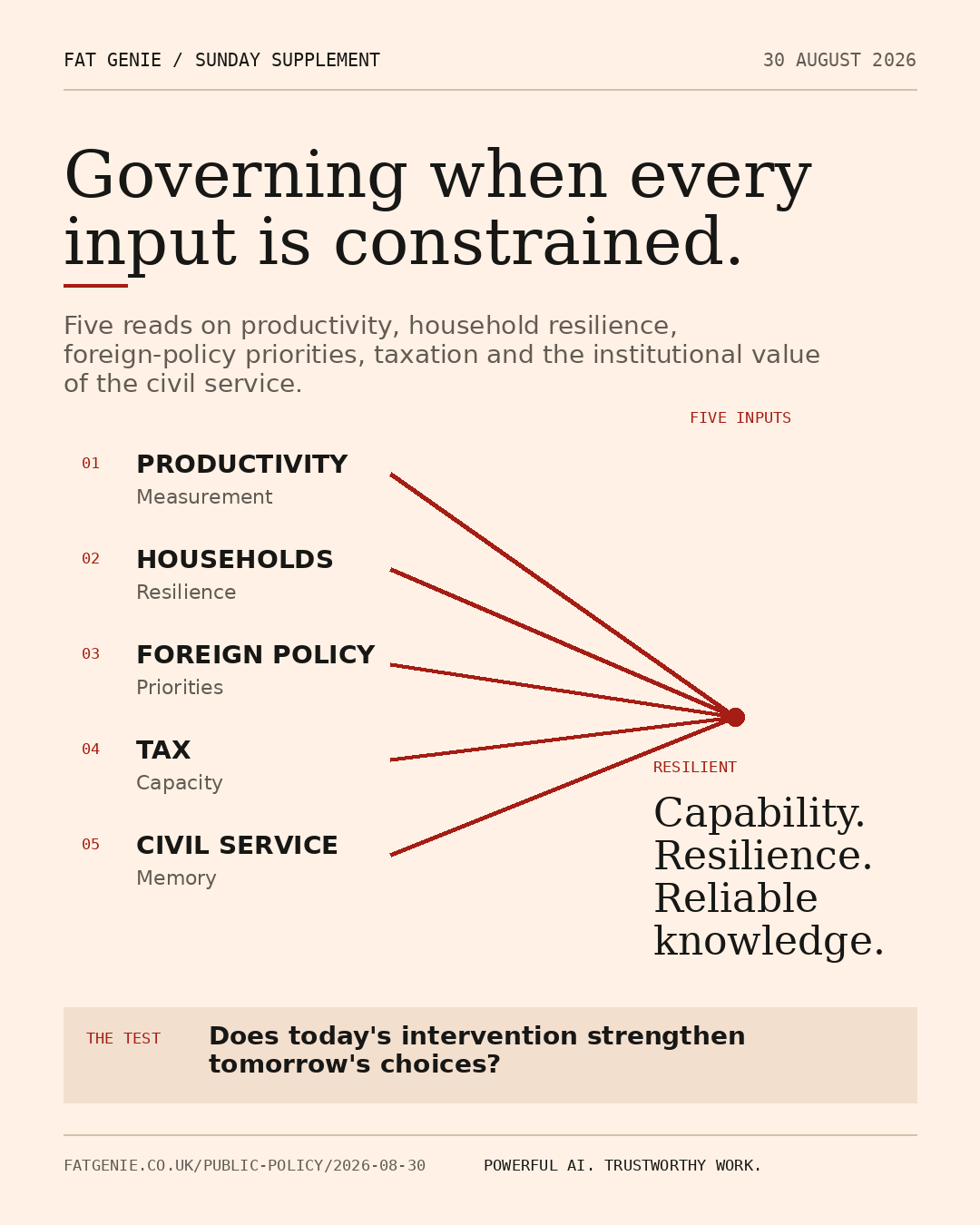
The strongest policy is not merely the intervention that improves today’s outcome; it is the intervention that improves today’s outcome while strengthening the stock of capability, resilience and reliable knowledge from which tomorrow’s choices will be made.
Administrative tax data point to a stronger recent productivity recovery than the headline Labour Force Survey implies, making measurement quality a live constraint on macroeconomic judgement.
Strongest objection
A short recovery window, subsequent data revisions and sector-composition effects could make the apparent improvement less durable than the alternative measure suggests.
What would change the judgement?
Track output per hour using payroll, self-employment and official labour-market series together, with sector-level reconciliation as later data mature.
Economic insecurity can become self-reinforcing when setbacks weaken planning horizons and financial buffers, leaving households more exposed to future shocks.
Strongest objection
Persistent household characteristics may drive both insecurity and weaker buffers, so longitudinal association does not by itself establish the full causal loop.
What would change the judgement?
Use panel evidence around exogenous shocks and buffer-building interventions to test whether improved resilience changes later insecurity and financial outcomes.
03
Foreign policy / strategic prioritisation
What the Burnham government should do in its foreign policy
With fiscal and military resources stretched, foreign policy needs a narrower hierarchy of priorities centred on national security, the economy and international influence.
Strongest objection
A deliberately narrow strategy can underweight obligations, regional contingencies or emerging threats that do not fit the initial hierarchy.
What would change the judgement?
Compare actual diplomatic, defence and aid resource allocation with the declared priorities, then assess whether outcomes and crisis responses remain coherent with them.
The tax system needs to adapt to ageing, wealth concentration and technological change while sustaining revenue, legitimacy and incentives.
Strongest objection
Some future-facing tax instruments would be administratively difficult, vulnerable to behavioural response or dependent on international coordination.
What would change the judgement?
Microsimulate incidence and revenue, then specify observable triggers around labour share, AI rents, avoidance and distribution before activating more novel instruments.
05
Institutions / civil service
The Civil Service: A Public Good, Not the Enemy Within
A permanent and substantially impartial civil service provides continuity, institutional memory and a constitutional public good that should not be discarded casually.
Strongest objection
Strong insulation can also create distance from elected ministers, weaken responsiveness or make poor performance harder to correct.
What would change the judgement?
Compare implementation quality, turnover, institutional learning and accountability in systems with more politicised senior appointments against those retaining stronger impartiality protections.
Trend watch
Productivity measurement divergence: WATCH. Governing through explicit constraint: WATCH.
The two signals recur across otherwise different policy domains, but neither was yet strong enough in this edition to treat as an established governing pattern.
Trend Watch follows a recurring theme across editions. So far, WATCH marks a signal we've noticed in one edition, and EMERGING marks one that has recurred across several editions but is not yet a settled governing pattern.
Fat Genie's AI researches and drafts each edition. Craig Cox reviews it and signs it off before publishing. This is Fat Genie's own analysis of publicly available research — it is not written, reviewed or endorsed by the organisations whose work it cites.