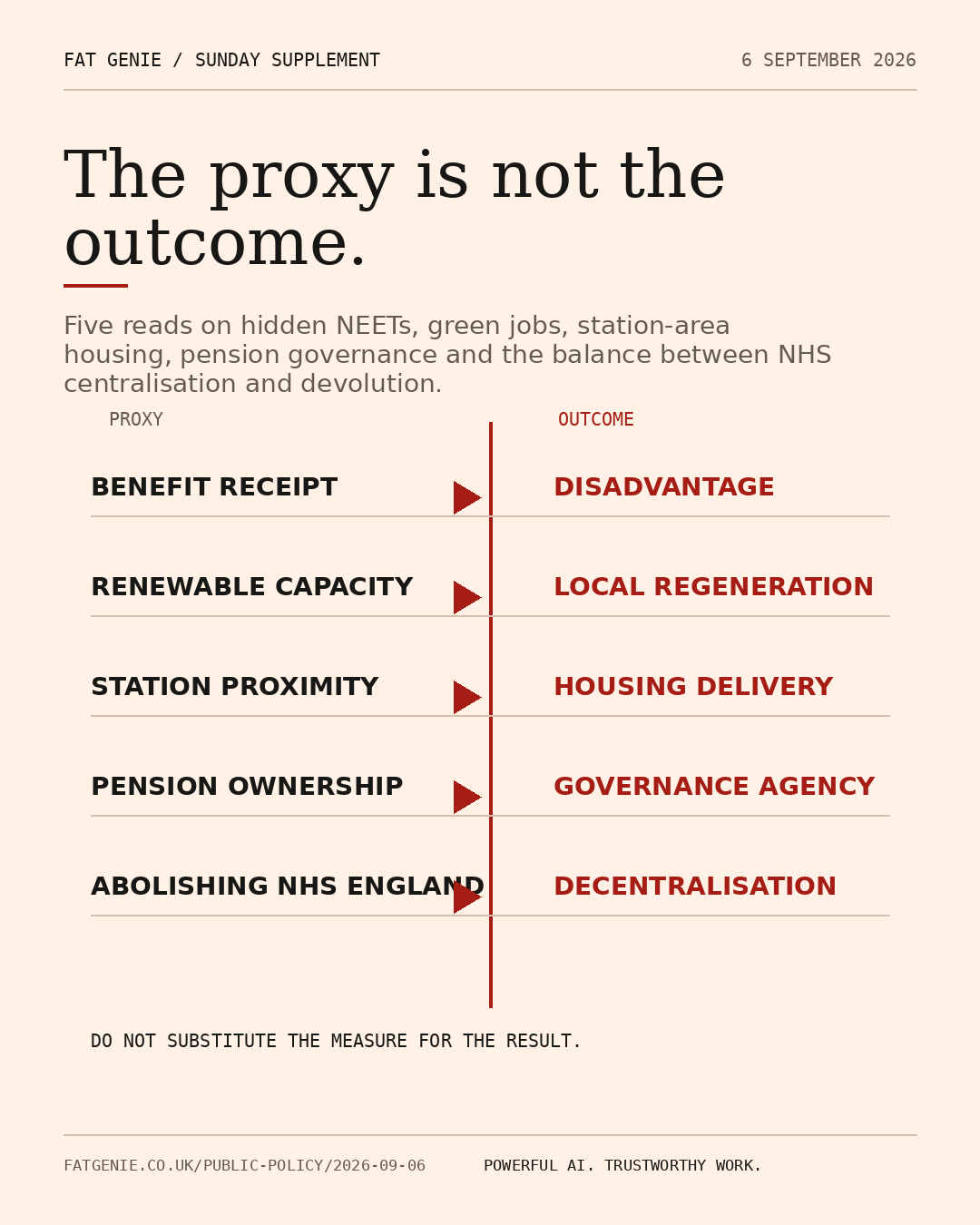
The common failure mode this week is proxy substitution: benefit receipt is not disadvantage; renewable capacity is not local regeneration; station proximity is not housing delivery; pension ownership is not governance agency; abolishing NHS England is not decentralisation.
01
Employment / measurement
Off the radar: who are NEETs not claiming benefits?
Not claiming benefits is a poor proxy for being especially detached from the labour market: many hidden NEETs are actively looking for work or in temporary transitions.
Strongest objection
The most disadvantaged young people can be under-represented in surveys, and evidence centred on ages 22–23 may not fully describe all 18–24-year-olds.
What would change the judgement?
Link longitudinal survey and administrative data to later employment, earnings and benefit outcomes, with particular attention to longer-duration hidden NEETs.
02
Net zero / local growth
Second wind: How can green industries contribute to local economic growth?
Green industrial capacity does not automatically translate into local regeneration; places such as Aberdeen and Grimsby need more active sequencing, concentration and local economic strategy.
Strongest objection
Targeted place policy can lock resources into politically salient industries or locations even where market conditions and comparative advantage are weak.
What would change the judgement?
Measure local employment, wages, value added, firm entry and supply-chain depth before and after targeted green-industry interventions.
03
Housing / urban productivity
Mind the density gap: How Britain’s big cities can build more homes near train stations
Higher-density housing around stations can increase supply, access to opportunity and urban productivity, but proximity to transport does not itself deliver homes.
Strongest objection
Planning reform can be constrained by infrastructure capacity, land assembly, viability, affordability and local displacement effects.
What would change the judgement?
Track completions, affordability, land values, commuting patterns and infrastructure pressure around stations affected by the new planning framework.
04
Pensions / economic governance
Whose Capital?: The case for building democratic accountability into Britain’s pension system
As pension savers bear more investment risk and pension capital gains economic influence, governance should give members more voice and greater transparency.
Strongest objection
More representative governance does not automatically improve investment decisions and can create tension with fiduciary duties or politicise asset allocation.
What would change the judgement?
Compare governance reforms against costs, returns, stewardship behaviour, member participation and trust rather than assuming ownership translates into effective agency.
05
Health / institutional design
Briefing: Health Bill – report stage and third reading, 7–8 September 2026
The Health Bill risks concentrating ministerial control in ways that conflict with stated ambitions for NHS and local devolution.
Strongest objection
Clearer ministerial authority can also reduce fragmentation and make responsibility for system performance more visible.
What would change the judgement?
Track appointment powers, local decision latitude, commissioning capability and performance after implementation rather than treating organisational abolition or formal delegation as proxies for decentralisation.
Trend watch
Governing through explicit constraint: EMERGING.
Devolution–centralisation friction and productivity-measurement divergence remained at WATCH. The repeated signal was that institutional labels and administrative proxies are increasingly poor substitutes for the outcomes policy is actually trying to change.
Trend Watch follows a recurring theme across editions. So far, WATCH marks a signal we've noticed in one edition, and EMERGING marks one that has recurred across several editions but is not yet a settled governing pattern.
Fat Genie's AI researches and drafts each edition. Craig Cox reviews it and signs it off before publishing. This is Fat Genie's own analysis of publicly available research — it is not written, reviewed or endorsed by the organisations whose work it cites.