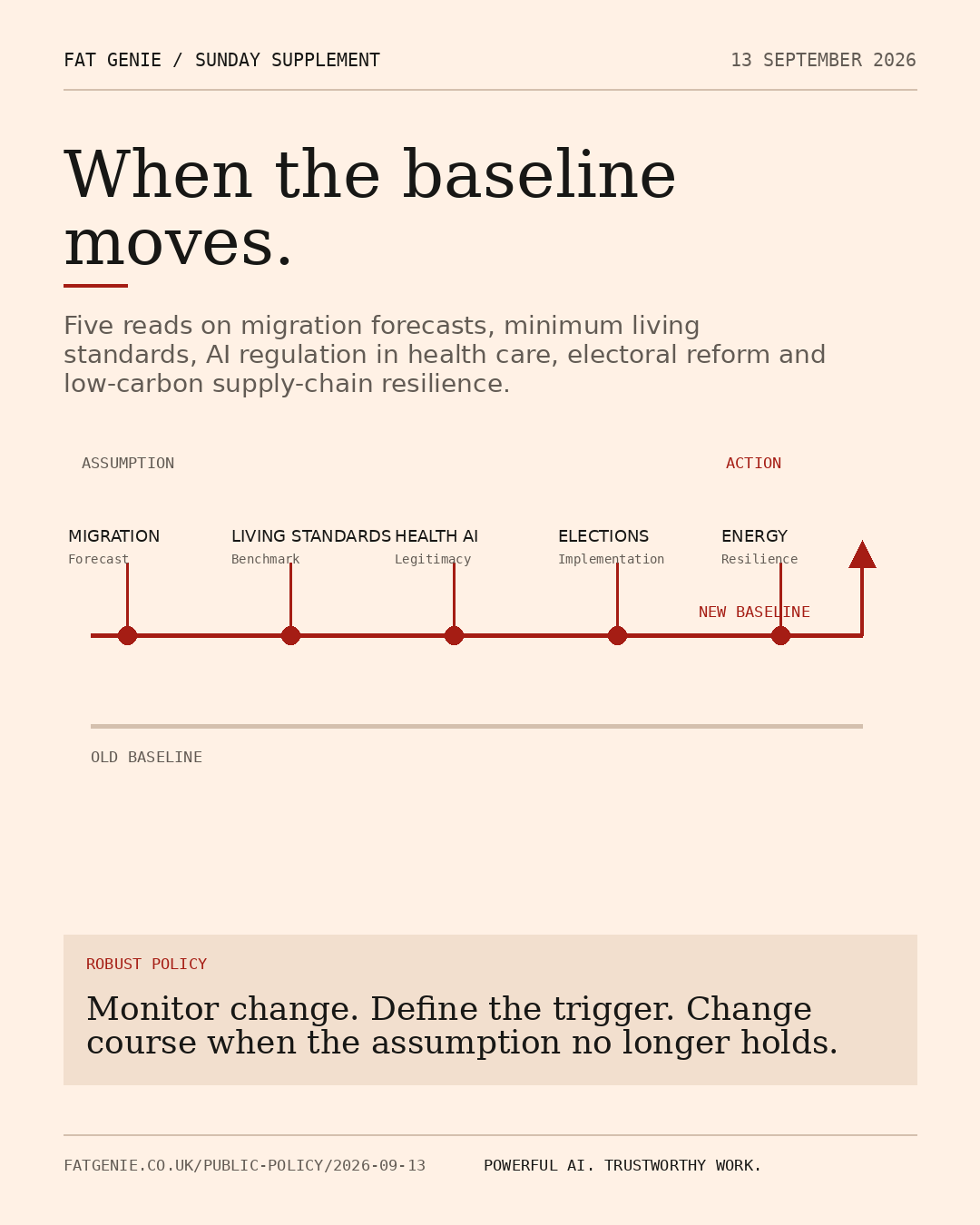
Five long-form reads on migration forecasts, minimum living standards, AI regulation in health care, electoral reform and low-carbon supply-chain resilience.
The common problem is baseline dependence. When load-bearing assumptions move, a system can keep operating mechanically while becoming substantively wrong. Robust policy therefore needs to monitor change and specify when that change should trigger action.
The fiscal effect of migration depends on uncertain levels, composition and duration, so a five-year public-finance forecast needs more than a single net-migration assumption.
Strongest objection
Greater route-level modelling can add complexity without resolving the wider general-equilibrium and long-run uncertainties that dominate fiscal effects.
What would change the judgement?
Compare route-specific assumptions with later migration out-turns, tax receipts and spending, and publish forecast-error decomposition as estimates are revised.
02
Living standards / social policy
A Minimum Income Standard for the United Kingdom in 2026
An acceptable living standard includes participation, relationships, choice and access to services as well as basic material subsistence.
Strongest objection
A socially negotiated basket is a normative benchmark rather than a direct measure of fiscal capacity or an automatic entitlement level.
What would change the judgement?
Compare the standard with actual expenditure, deprivation, well-being and regional cost variation, and monitor how the basket changes as public expectations and prices move.
03
AI / health regulation
The public’s views on the regulation of AI in health care
Public support for health-care AI is conditional: safety, accuracy, human oversight and protection against unequal outcomes are central to legitimacy.
Strongest objection
Stated preferences in polling and deliberation may differ from choices people make when the benefits, costs and risks of a concrete clinical use are visible.
What would change the judgement?
Measure acceptance, safety incidents, error patterns, inequality and human-override behaviour in real deployments across different risk levels.
04
Elections / institutional implementation
Representation of the People Bill: HL Bill 47 of 2026–27
The bill combines changes to the franchise with measures addressing electoral integrity and foreign financial influence, placing substantial weight on implementation and enforcement capacity.
Strongest objection
Legislative changes alone cannot guarantee participation, prevent influence or resolve every enforcement problem in a complex electoral system.
What would change the judgement?
Track registration and turnout among newly enfranchised voters alongside compliance, enforcement activity and evidence of attempted circumvention after commencement.
05
Energy / supply-chain resilience
Supply chains for low carbon electricity infrastructure
Low-carbon electricity infrastructure depends on concentrated global supply chains for critical minerals, processed materials and specialist manufacturing, creating potential resilience risks.
Strongest objection
Concentration is not identical to vulnerability, while diversification, stockpiling or domestic capacity can increase costs and slow deployment.
What would change the judgement?
Monitor supplier concentration, lead times, input costs, inventories and recovery from real disruptions rather than using country share alone as the resilience metric.
Trend watch
Governing through explicit constraint remains EMERGING.
Devolution–centralisation friction and productivity-measurement divergence remained at WATCH. This edition added a sharper test: whether institutions detect material changes in their assumptions early enough to alter policy rather than merely continue processing against a stale baseline.
Trend Watch follows a recurring theme across editions. So far, WATCH marks a signal we've noticed in one edition, and EMERGING marks one that has recurred across several editions but is not yet a settled governing pattern.
Fat Genie's AI researches and drafts each edition. Craig Cox reviews it and signs it off before publishing. This is Fat Genie's own analysis of publicly available research — it is not written, reviewed or endorsed by the organisations whose work it cites.